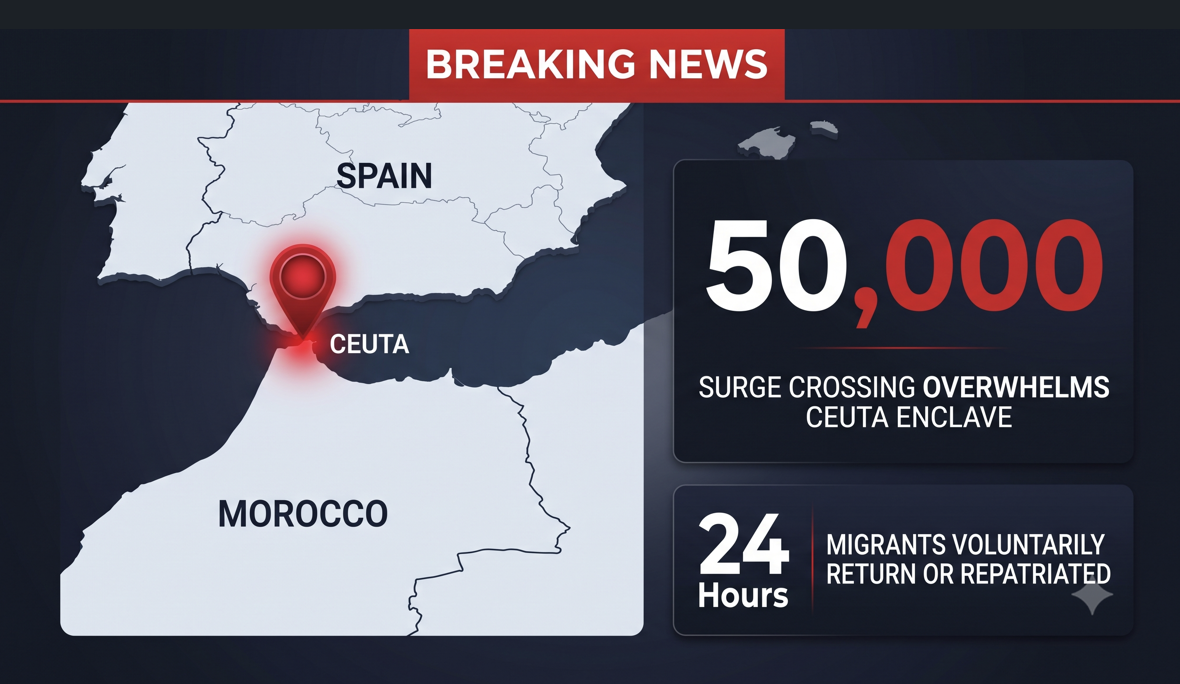
CEUTA, Spain — Tens of thousands of migrants crossed from Morocco into the Spanish North African enclave of Ceuta over the course of a single day, overwhelming local authorities and triggering a major diplomatic and humanitarian response across Europe.
Officials estimate that up to 50,000 individuals breached the border zone, prompting Spanish Prime Minister Pedro Sánchez to make an emergency visit to the territory. During his visit, Sánchez announced a significant boost in police and military presence along the border, unveiled plans to construct a reinforced sea barrier, and ordered the acceleration of return procedures.
Mass Repatriations and Border Response
Following the unprecedented single-day surge, Spanish authorities immediately initiated steady repatriation efforts. Thousands of migrants were sent back across the border within the first 24 hours, while a large number of individuals have also opted to return to Morocco voluntarily.
-
Security Reinforcements: Additional police units and security personnel have been deployed to secure the beachfront and border fences separating Ceuta from Morocco.
-
Sea Barrier Construction: Madrid plans to erect a specialized maritime barrier designed to prevent future large-scale swimming and wading crossings along the coastline.
-
Accelerated Returns: Coordination with Moroccan border officials has enabled swift pushbacks and structured repatriations, relieving pressure on Ceuta's municipal infrastructure.
European and International Repercussions
The scale of the influx has ignited intense political debate within Spain and across the European Union. Vocal critics and opposition leaders characterized the surge as an "invasion enabled by policies," arguing that Madrid's border management has left the enclave vulnerable.
The event has also sent ripples through broader European border policy:
-
Schengen Area Scrutiny: Key EU member states—including Italy, Denmark, and Sweden—have reportedly considered temporarily suspending free movement rules at Europe's external borders amid mounting migration pressures.
-
U.S. Reaction: United States officials offered general support for border security cooperation but pointedly referenced Madrid's diplomatic and immigration approach as a central factor in the unfolding situation.
As repatriation operations continue, Spanish officials remain on high alert along the coast of Ceuta, working to restore normal border operations and manage the humanitarian impact on the enclave.
